Growth Hacker Marketing Tools

The Growth Hacker Marketing movement is gaining momentum. ‘Growth Hacking’ isn’t the easy way to reach your customers, because that doesn’t exist.

It’s the recognition that the most successful new startups don’t rely on big media and advertising budgets to reach their customers. Instead, they target precisely the right segment.

Communities of people who naturally look our for a type of product you offer.

Then, using digital channels, they:
  • create buzz and scarcity (e.g. invite only for the launch of gmail)
  • optimise the customer experience
  • constantly improve their product
  • use customer feedback to grow

This slideshare includes some of the tools we can all use to optimise our marketing. I hope you find it valuable.

My recommended reading list includes a book on Growth Hacking by Ryan Holiday. It’s a great read.

Have new posts sent to your inbox. Sign up.

Too busy

Too busy

“I work long hours.”

“I’m so busy, you know how it is.”

It can mean 2 things.

They’re a hard worker. Their proud of their work and they need to put in extra time to achieve the quality they set for themselves.

They’re inefficient and easily distracted by various inboxes and impulse tasks. In an attempt to hide it, they work longer, hoping that by doing more people won’t notice they’re achieving less.

Too often I’m the latter. Which one are you?

Have new posts sent to your inbox. Sign Up.

Tribes have changed

Tribes have changes

As cavemen (and women) we stuck together. Or tribe was our family and without one you didn’t have protection, food or connection.

Now our tribes are our passions. It’s the stand up board riders, banjo players, local tennis club and yoga class.

If you can align your business with a tribe and connect with that community on a personal level (not selling to them) you can totally change the way your fans think about you. If you contribute to the tribe, you’re one of them.

You can earn trust by being authentic. By being human. Where’s your tribe?

Join my tribe: Subscribe.

Making products for the market

We know it’s wrong but we can’t avoid it. When we make new products we always bring our own interests to the table.

‘Those people don’t use Twitter.’

‘We should charge 99c. That’s how Apple price their apps!’

‘Our market prefers to contact us on Social Media.’

Of course, these assumptions are based on ourselves, and we try hard to apply them to our market because we desperately want to be our target market. But we’re not.

That leaves us with two choices. Drop the assumptions and make products for the market (not like us) or keep making products that we like and go bankrupt.

Subscribe

The ultimate test of design

ios7

When we design or create things, it becomes more about how it looks than what it does. Appeal over function.

The irony is that users quickly forget what looks great. But if it works and is relevant to our needs we’ll use it every day.

The goal should be ‘how can we make this relevant’, not ‘how can we make this look great?’

The wisdom of 80/20

The 80/20 rule is one of the most well-known theories of management and marketing.

20% of your customers, messages, employees or time give you 80% of sales, conversions and output.

It’s ironic that this is one of the rules we get wrong so often.

Why? We chase our losses. It’s a common reason for problem gambling where we fail to recognise what’s causing us so much damage.

Every time you ignore the evidence that your social media marketing is draining your time, or that your sales mainly come from a demographic you don’t particularly like, you chase your losses.

Refusing to accept where your 20% is and cutting out the ineffective 80% is a quick road to disappointment.

Let’s be more honest with ourselves and make sure our efforts are spend in the most valuable places.

Choose to love your customers

We often forget that our customers are just like us. They are perceptive and intelligent.

So why do we treat them like extra work? Why do we sigh and moan about how much stress they cause us?

Let’s choose optimism over cynicism.

Serve them like you would serve your own family, because the easiest way to lose a customer is to treat then like one.

The Chromecast ad and 2 reasons why it’s almost perfect.

We’re used to advertising that’s full of stereotypes, poor humour and irrelevant imagery.

This one’s different and there’s 2 reasons why it works so well:

  1. It let’s you experience the product. Most ads tell you why you should buy the product. They try and convince you that the price and benefits are worth the effort of making a purchase. This ad gives a glimpse into what it feels like to use the product. It feels great to be with friends and family watching the content we love on the big screen. It feels like we’re there and this product will make those good times even better.
  2. There’s only one message. This isn’t a magic trick or a slight of hand. It’s a very simple product that you plug into your tv and it plays content you love. It’s easy and so is the ad.

The biggest thing to take away from this ad is that simplicity works and we should always focus on how the product makes you feel.

3 reasons Apple don’t need social media.

Apple

  1. Their customers spread the word for them. Not only are there multiple forums dedicated to analysing every word uttered by Apple representatives, people camp out for days to get their hands on the latest release.
  2. Apple’s keynote presentations, media statements, updates and, most importantly, buzz about new products is all the content they need. Every rumour, leaked or authentic, is published by thousands of news sites. When Apple sneezes, or just loses an iphone prototype in a bar, the world goes nuts.
  3. Their service is quality. Many brands use their social channels to respond to feedback and support questions. Apple are great at doing this in store and in the user-supported online communities.

Image CC Martin Abegglen

Why there’s no such thing as neutral.

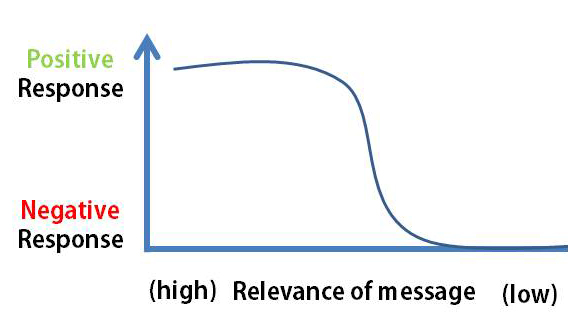
Neutral is negativeThe problem with neutral messages (ignored by your audience) is that they aren’t actually neutral.

Every time we interrupt someone’s day with our message we are asking for permission. Permission to get inside their head and prove that we have something to offer them.

Too many times we fail to offer anything of value. And each time we fail, we don’t just get another free go. We lose some, if not all, of the influence we once had.

It could be that our target is too big (not targeted) or, more likely, the idea sucks.

When I watch a mediocre TV ad, I not only ignore it’s message, I actively detest the brand forever. “What a waste of time,” I think to myself.

Your audience does the same. Whenever we interrupt a colleague with useless news or complain about trivial frustrations we lose the permission to do it next time and the opportunity is lost.

Communication is not a right, it’s a privilege we can’t afford to waste.

Where’s the leak?

20130726-074857.jpg
We all spend time and money on different ways to get customers or to keep them.

But how do we know what works? Many assume that spending more money on advertising is the answer to all business problems.

But many times we fail to measure how effective each message is and, usually, we find out that we aren’t breaking even on each ad we buy.

Turning the tap on harder when the pipe is leaking is only going to make the leak worse. The truth is we might be better off handing out the money on the street.

So make sure you know, really know, where you’re leaks are and understand that more doesn’t always equal better.