Controllable

In any business, it’s easy to stress about the external factors that can bring us down.

It could be the economy, your customers, the industry or government. Things can go bad quickly.

However, many times we use these factors as excuses or as reasons to not invest as much time and effort into what we can control.

Sure, traffic to your site will fluctuate. Customers might out away their credit card in January.

But when the opposite happens, and it will, there will be no excuses as to why you didn’t take full advantage of it.

If the customer journey is broken, or illogical, sales will pass you by.

If we make the most of the uptrends, the down trends won’t hurt so much.

Fixed or flexible

flexible

It’s frustrating when someone comes along and ditches the plan. The plan we all agreed was the best path. The one we graphed and colour coded and said, in unison, ‘approved’.

It’s also frustrating when someone can’t break from the plan. The plan that is so constrictive, inflexible. The plan that’s stopping us from making something even better.

Both ways of thinking are perfectly fine, but can be equally dangerous.

Often I find myself in both camps. When I’m invested in the plan, I can’t stand it when people break it. When I want to break the plan, I can’t stand people who want to keep it.

Understanding the type of people you work with (and for), either planners or breakers, is a massive help.

Subscribe to my mailing list

2 ways to take advice

  1. Ignore it. Pretend like you’ve heard it all before and that you should be the one giving them advice, not receiving it. Nod and say, ‘yeah, I do that already but it doesn’t work’.
  2. Even if we’ve heard it all before, listen. Think about why they’re telling it to you. What are their perceptions of you? What experiences have they had that you can learn from without making the same mistakes. Thank them. Ask them more questions. Sure, ignore the things you disagree with, privately. Everyone can learn something from someone else.

Advice is a gift and often helps us skip the most painful experiences because someone was kind enough to warn us or show us the way. Who can you give advice to today? Who do you need to listen to more?


I dare you

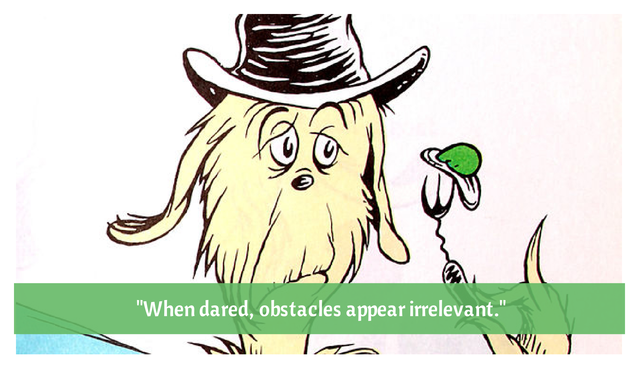
Green Eggs and HamDr. Seuss wrote Green Eggs and Ham after his editor challenged him to write a book using less than 50 words.

What happened? He wrote one of the best kids (and adult) books of all time. A creative classic. Poetry and art in a few pages.

When asked nicely, a work of art that transcends generations is rarely produced.

When dared, obstacles appear irrelevant. Motivation peaks and the creative juices flow freely.

So when you’re asked to do something impossible, dare yourself.

How do we know what we’re capable of unless we attempt the impossible?

Deliver at all costs

delivery
Photo: npr.com

Not delivering is the worst thing you can do. It gives me a feeling of dread in the pit of my stomach.

Sometimes we stall and delay because we’re afraid of showing people our work or being judged on the quality.

But the results are secondary, really. And the benefit of hindsight means we can improve, optimise and learn for next time.

If Amazon delayed delivering a book you ordered because they thought you might just return it, or write a bad review, you’d be mad.

So, let’s keep our commitments. Even if it’s the worst thing you’ve ever done, ship it. Press send. Turn up. Apply.

Then learn from it. Doing nothing is worse than doing something badly.

What if

What if we went global
What if we closed our shops
What if we worked at a round table everyday
What if we answered the phone without any recordings
What if we dropped everything for that great idea
What if we linked our salary to customer satisfaction
What if we called our customers to ask what they like
What if we donated our profits

What if we broke the rules

Working backwards

We usually get stuck when charging ahead, blasting through the steps, until, suddenly, we can’t go any further.
Running full speed our heads down blocks the vision of the end goal. Sometimes we end up off track, with a product nobody asked for or wants.

Another way: do it backwards. Keep in mind the end goal – from the start.

If things go perfectly, what will we end up with? Answer that, and you’ll find it much harder to get lost.

5 questions to ask before you share

Some brands try to post content to all social media platforms without understanding the different audiences, expectations and effectiveness of each. So, before you sign up to the latest platform and press ‘post’, ask yourself these 5 questions:
Simplicity is the key

  1. Are my customers here?
  2. Will they listen?
  3. Will they share what I post with people who could become customers?
  4. How much extra time will it take to post here?
  5. What is the most engaging type of content to post? (not the same across platforms)

If you can answer all of those questions then you can make a decision. And it’s perfectly ok to say no.

Who are you?

Guess Who

Most marketers obsess with who they’re targeting. What demographic? Location? Income?

All good questions. However, we can’t afford to ignore our current customers.

In fact, a qualifier for looking for more sales should be an intimate understanding about who our existing customers are.

How do they think? Why did they stick around? How do they feel about us?

This helps us reach similar people and help spread the word in already existing communities.

There’s no point reaching a new segment if one exists, untapped, right before your eyes.

There goes the shop

Whoops, there goes the shop.

The place you invested so much time in just disappeared overnight. No fire, flood or lightning strike.

It’s gone – vanished.

If this really happened we’d be shocked.

And it just happened. The physical store has all but vanished for many industries. It’s not coming back, ever.

Like most hobbies of obese Westerners, shopping is done on the lounge with a smartphone.

How will we adjust to this digital way of life? Can we still connect and build relationships on a 6 inch screen?

Do people behave differently when searching for things in a store compared to on a phone? Can we still grow our business without a physical address?

The answer is always yes. The how is much harder.

Storytelling in a world of noise.

devices

Perhaps one of the greatest trends in digital behaviour is a lack of concentration.

Tweets are short. We use multiple devices at once. Often, we never use apps more than once.

Information is everywhere, uncensored and almost free for all. How then, do we expect to keep telling our stories the same way? How can we expect to sell the same way as we did before – when people used to pay attention to ads and billboards?

All we know is that we can’t follow the status quo and sell the facts. We have to have a unique story or emotional connection to break through the noise.

2 things we can try:

  • Tell our story only to people who are predisposed to the product.
  • Tell it in a way that focuses on comedy, pain, fear or motivation – not on the boring facts.

How Apple stole Christmas

https://www.youtube.com/watch?v=v76f6KPSJ2w

What makes a great ad?

No mention of a product
Apple didn’t directly try to sell us anything. No prices, sales or loud people screaming at us to rush into store.

A story that connects
It’s about emotion, a simple story of family, creativity, love and a unique shared experience. It captures something we all hope for each Christmas. No complications, villians or heros – just a kid who uses his phone to make something special.

This ad is great because it makes us feel something without being sold something, but we still remember it’s from Apple.

People say the best authors write in a way that makes us think we could’ve written it. For marketers, this ad gives us similar hope. Anyone could’ve made this ad.

What story are you going to tell next year?